17 Christmas Tree Ideas That Bring Warmth To Your Home in 2026

Finding practical Christmas tree ideas in 2026 usually comes down to paring back rather than piling on extra ornaments each season. A healthy evergreen tree already introduces texture, rich shadow, and honest winter color into a home on its own natural merits.
The most welcoming holiday settings balance tactile materials with quiet, warm illumination. Combining matte earthenware finishes, unbleached textiles, muted botanical hues, and aged metal accents makes any pine or fir feel gathered over time rather than assembled from a matching box in one afternoon.
Below are 17 ideas you can adapt to your own space, whatever your interior style, to create a calm and grounded centerpiece this winter.
Drape Wide Velvet Ribbon in Soft Ochre

Broad fabric bands create gentle movement that stiff tinsel simply cannot match. Ochre provides an earthy warmth that sits comfortably against needles without competing for attention.
Cut two inch wide velvet ribbon into three foot lengths. Tuck one end securely near the trunk, letting the length cascade forward across two boughs before tucking the tail back inside. Twelve cut strips give a seven foot tree graceful cohesion without feeling wrapped.
The mistake here is creating tight loops or formal bows. Let the weight of the fabric do the shaping.
Soft folds catch the room light, yielding an understated presence.
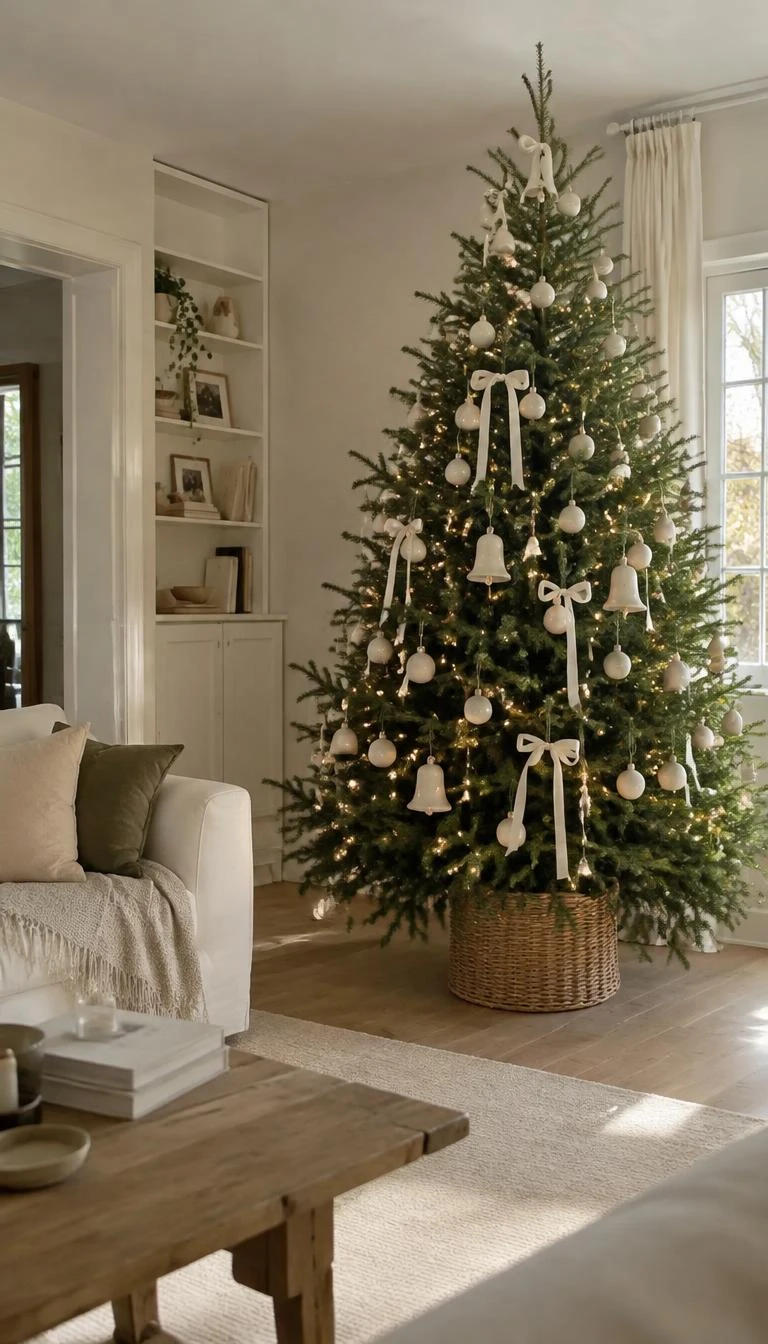
Hang Antiqued Tin Bells from Raw Linen String
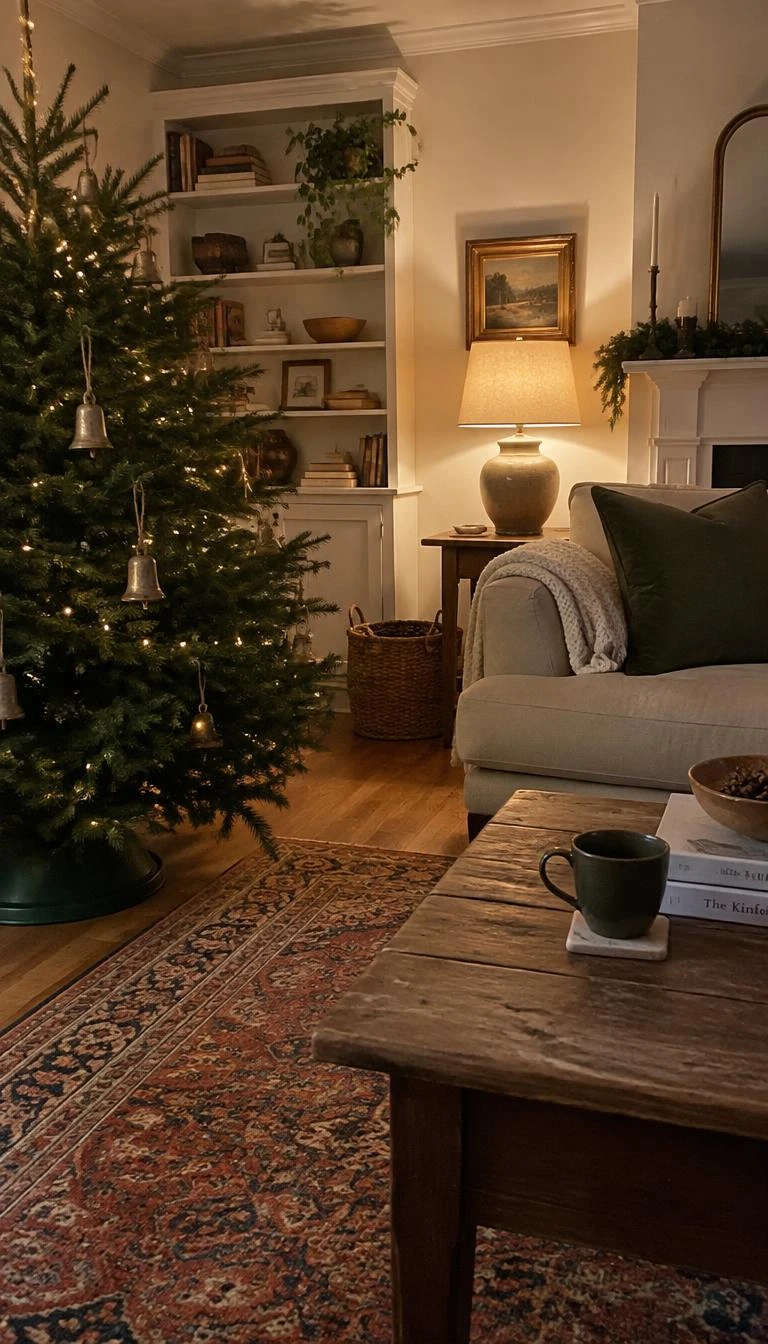
Hollow tin bells offer an aged, quiet charm that polished chrome or brass never achieves. Their muted grey and zinc surfaces absorb light instead of bouncing harsh glares across the room.
Cut unbleached linen twine into six inch lengths. Tie twenty small bells to sturdy inner branches, spacing them loosely from top to bottom.
I like hanging these near branches where people walk by, so their faint chime occasionally rings out.
Keep the bells varying in size between one and two inches across. The matte metal grounds the branches, creating a steady, rustic appearance.
Pair Matte Terracotta Baubles with Warm White Fairy Lights

Unglazed clay brings an unexpected earthiness to evergreen foliage. Paired with warm lighting, the reddish clay tones mimic winter embers.
Weave three hundred warm white lights directly along the inner trunk before moving to the branch tips. Then hang roughly twenty five smooth clay spheres across the middle branches.
The mistake is choosing glossy terracotta. The clay must stay entirely unglazed to catch the tiny light points cleanly.
This combination suits minimalist rooms with light plaster walls. The tree looks earthy, peaceful, and warm.
Fill Lower Branches with Clustered Paper Mache Spheres

Tree bottoms often look bare or uneven compared to dense tops. Generous paper mache globes add instant visual weight where a tree naturally spreads widest.
Select spheres measuring four to five inches in diameter, finished in raw oatmeal or chalk white. Cluster them in groups of three on the heaviest lower branches, resting them securely against the wood.
Avoid hanging them from delicate tips. Paper mache holds bulk, so tucking them into branch junctures looks intentional and grounded.
They anchor the entire display, balancing the narrower top branches with balanced proportion.
Scatter Dried Sliced Pears Across Dark Green Foliage

Dehydrated fruit provides an organic alternative to manufactured glass shapes. Dried pears in particular develop thin, paperlike centers that glow when lit from behind.
Slice firm pears lengthwise to preserve their natural silhouette and seeds. Bake them low at two hundred degrees until completely dry. Loop brown cotton thread through the stems and hang thirty slices directly in front of light diodes.
The key is slicing them evenly so light passes right through the flesh.
Against dark spruce boughs, they read like amber stained glass.
Group Clear and Frosted Ribbed Glass Ornaments

Texture can provide richness without needing bright pigment. Ribbed glass splits the light, while frosted surfaces soften it.
Alternate between three inch clear fluted spheres and frosted teardrops. Place the clear glass toward the outside to catch room reflections, and keep the frosted pieces further back to diffuse the tree lights.
Thirty mixed glass shapes give a standard six foot tree plenty of visual dimension.
Avoid mirrored mercury finishes here. Plain ribbed and frosted glass feels calmer and lets the needle color remain the true focal point.
Use Muted Olive Green Velvet Instead of Traditional Red

Monochromatic decorating does not have to feel cold. Olive green ribbon introduces quiet luxury by blending subtly with pine needles rather than shouting for attention.
Source one inch wide cotton velvet ribbon in a dusky army olive. Tie fifteen simple shoelace bows with four inch tails directly onto branch tips.
I prefer this approach in rooms that already feature rich wood and warm leather.
The eye notices the variation in sheen between velvet pile and waxy pine foliage. The overall tree looks unified, collected, and remarkably serene.
Tuck Feathered Eucalyptus Sprigs Toward the Trunk

An artificial or sparse natural tree can gain genuine volume when layered with secondary foliage. Preserved eucalyptus provides silvery blue undertones and round leaf shapes.
Take twenty dried stems and insert them horizontally near the trunk, pointing slightly upward. Let their leafy tips poke out two inches past the evergreen needles.
The mistake is placing them exclusively on the outside edges, which looks clumsy.
Pushing them far into the center fills negative gaps cleanly. The mix of contrasting leaves creates a forest floor richness that feels wild yet controlled.
Layer Raw Brass Geometric Shapes on Slender Twigs

Polished gold can easily read as harsh, but untreated raw brass oxidizes into a quiet, warm tone.
Choose flat, stamped brass discs, triangles, and thin diamonds no larger than two inches. Hang them using fine jewelry wire so they dangle freely from the outer boughs.
Keep to twenty pieces. Too many brass ornaments turn the tree into a metallic showpiece.
When the furnace kicks on or someone walks past, the metal spins softly. Each rotation catches a glint of amber light across the room.
Suspend Small Wooden Stars Bound with Jute Twine

Scandinavian simplicity relies on pale, natural timber to break up dark winter evergreens. Untreated wood adds honest simplicity without any fuss.
Look for turned beech or carved pine stars around three inches across. Fasten each one with a simple loop of coarse jute twine, keeping the knot visible.
Hang them strictly on the middle layer of branches where their flat surfaces rest parallel to the needles.
The key is leaving the wood unfinished. Sealed or varnished pieces lose their pale warmth, whereas raw grain complements green boughs immediately.
Choose Cast Iron Tree Collars Over Fabric Skirts

Fabric skirts bunch up, gather falling pine needles, and require constant smoothing. A heavy metal collar gives the tree base an architectural finish that stays put all season.
Select a dark bronze or cast iron ring that stands roughly ten inches tall. Measure your tree stand diameter first to ensure at least two inches of clearance on every side.
Black metal anchors the base visually, grounding the airy branches above.
Sweeping fallen needles becomes simple. The tree feels firmly planted in the room, neat and deliberately positioned from floor to crown.
Thread Strands of Pressed Wax Beads Between Outer Boughs

Plastic beaded chains feel dated, but hand rolled wax beads carry a translucent, candlelit softness.
String small honey colored beeswax beads along thin cotton thread. Drape three nine foot garlands gently around the tree, allowing each loop to dip six inches between branch tips.
Start two thirds of the way down and work upwards so the garlands do not crowd the bottom.
The beeswax holds a soft honey aroma that warms up under tree lights. The gentle yellow beads create subtle horizontal lines without breaking the silhouette.
Add Smoked Amber Drops Near the Trunk

Most people hang glass ornaments exclusively on the exterior tips. Placing glass far inside the tree reflects hidden lights and gives the whole evergreen inner luminosity.
Choose teardrop ornaments in smoked amber or honey colored glass. Hang eighteen to twenty pieces directly from the main trunk and inner branch forks, adjacent to individual bulbs.
The mistake to avoid is using bright colors inside. Smoked amber warms the shadows without looking messy.
Stepping back, the tree seems to glow from its heart rather than just across its outer surface.
Balance Heavy Felted Wool Baubles Across Middle Layers

Dense wool absorbs sound and light, bringing a softening texture that balances brittle glass.
Pick felted spheres made from boiled wool in cream, charcoal, and warm stone. Hang fifteen baubles across the middle third of the tree, resting each sphere against a needle cluster to support its weight.
Keep the sizes uniform at roughly two and a half inches. Mingling sizes here makes wool feel lumpy.
In a room with plaster walls and hardwood, felt provides tactile comfort. The ornaments look tactile, durable, and wonderfully quiet.
Top the Crown with a Clipped Botanical Branch

Traditional commercial tree toppers often appear rigid or out of proportion with the rest of the greenery. A natural botanical branch extends the tree line fluidly.
Cut three dried stems of magnolia leaves, dried pepperberry, or sturdy berry branches. Bind them with floral wire behind the tree leader, letting the stems fan outward five inches above the peak.
I like using branches with contrasting brown and olive leaves.
The top feels organic and alive. It completes the tree without demanding attention like a plastic star.
Drape Loosely Woven Cotton Garland Vertically

Spiral garlands can look chaotic and break the natural vertical growth lines of a fir tree. Vertical draping draws the eye up and emphasizes ceiling height.
Cut unbleached woven cotton ribbon into eight foot lengths. Fasten each strip near the top crown and let it fall straight down through the branches, touching tips lightly on its path.
Use seven or eight vertical lines around the tree.
The key is leaving the ribbons untamed. The gentle ripples frame your ornaments cleanly and give the tree an elongated, stately poise.
Place Fluted Metal Stars Under Lower Needles

Low branches often sit in shadow, causing the tree base to disappear in dim lighting. Dull zinc stars pick up floor level glow.
Select six five inch three dimensional stars stamped from dull zinc or galvanized tin. Hang them two inches behind the lowest branch tips using dark wire.
The mistake is using shiny silver, which clashes with warm lighting. Dull zinc has a weathered patina that works with dark greenery.
As evening settles, the metal catches residual light from rugs and lamps, completing the lower tree profile.