8 Best Dehumidifiers for Basements 2026

This post may contain affiliate links. As an Amazon Associate I earn from qualifying purchases. If you choose to make a purchase, I may earn a small commission at no extra cost to you.
A damp basement can leave stored boxes musty, make laundry take longer to dry, and keep the room uncomfortable. A dehumidifier pulls moisture from the air, but the right size depends on how much space you need to cover and how often you can empty its tank.
For a basement, check capacity and coverage first, then compare hose drainage, humidity controls, noise, and energy use. The best dehumidifiers for basements in 2026 should match your room and routine, not just capacity.
The AEOCKY RHEA-001 is our top pick, with 80-pint daily capacity, 5,500-square-foot coverage, precise humidity monitoring, and a 44 dB lowest fan setting. The list below includes options for large rooms, quiet operation, flexible modes, and small spaces.
Our Top Basement Dehumidifiers Picks

- Daily Capacity: 80 pints/day max
- Coverage: 5,500 sq. ft.
- Humidity Control: Precision humidity monitoring

- Daily Capacity: 80 pints/day max
- Coverage: 5,500 sq. ft.
- Drainage: 1.45-gal tank; 6.56-ft hose
- Daily Capacity: 80 pints/day
- Coverage: 5,000 sq. ft.
- Drainage: 1.14-gal tank; 3.3-ft hose

- Daily Capacity: 80 pints/day
- Coverage: 5,500 sq. ft.
- Drainage: 1.06-gal tank; 3.28-ft hose

- Daily Capacity: 34 pints/day
- Coverage: 2,500 sq. ft.
- Drainage: 0.45-gal tank; 3.28-ft hose

- Daily Capacity: 32 pints/day
- Coverage: 2,500 sq. ft.
- Drainage: 2.5-L tank; 3.28-ft hose

- Daily Capacity: 28 pints/day
- Coverage: 2,000 sq. ft.
- Drainage: 0.44-gal tank; 3.28-ft hose

PSOS Semiconductor Dehumidifier
- Daily Capacity: 40 oz/day
- Coverage: 1,000 sq. ft.
- Drainage: 98-oz removable tank
More Details on Our Top Picks
AEOCKY RHEA-001 Dehumidifier suits you if you need to control dampness across a large basement and want a highly efficient unit. It removes up to 80 pints per day in hot, humid conditions and covers spaces up to 5,500 square feet.
Its ENERGY STAR Most Efficient 2026 certification sets it apart from standard ENERGY STAR models in this group. You also get smart humidity monitoring, power-off memory, and low-temperature defrost sensors for cooler spaces.
The listed 44 dB low-fan setting gives you a useful noise reference, though this remains a full-size compressor model. AEOCKY RHEA-001 Dehumidifier also uses copper tubing and includes three-year coverage, but it has no listed tank or hose details for drainage planning.
Bottom line: Choose it for a large, damp basement where efficiency certification and humidity monitoring matter to you. Plan your drainage setup around your room, since the unit has no listed tank or hose details.
KNKA PD30MA-20 Dehumidifier gives you high-capacity moisture removal for spaces up to 5,500 square feet. It removes up to 80 pints per day in hot, humid weather and 56 pints per day in the stated warm-basement conditions.
The unit carries ENERGY STAR certification and runs at 40 to 45 dB. That makes it a practical choice near bedrooms or living areas, especially since you can switch off its humidity display and indicator lights.
You can set a target from 30% to 80% RH, use Auto or Dry mode, or connect the included hose for continuous drainage. KNKA PD30MA-20 Dehumidifier also has a washable filter and casters, though its built-in tank holds 1.45 gallons, so tank-only use calls for regular emptying in a damp basement.
Bottom line: Pick it for a large basement where you want ENERGY STAR certification, flexible humidity settings, and quieter operation. The included hose helps if you would rather not empty the 1.45-gallon tank by hand.
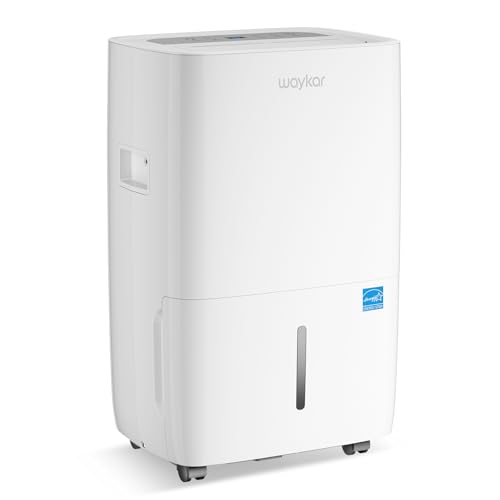
Waykar 80-Pint Dehumidifier is a strong fit if your basement needs high daily moisture removal and more even airflow. It handles up to 80 pints per day and covers spaces up to 5,000 square feet.
The 90-degree auto swing helps spread air around the room, while the humidity setting ranges from 30% to 80% RH. At around 42 dB, it also offers a measured noise level for a large compressor unit.
You can use the 1.14-gallon tank or attach the included drain hose for continuous gravity drainage. Waykar 80-Pint Dehumidifier adds auto defrost and overload protection, plus ENERGY STAR and other listed safety certifications, but its coverage falls below the 5,500-square-foot models in this group.
Bottom line: Choose this Waykar if you want broad coverage with a swinging airflow outlet and clear humidity controls. It suits you best when 5,000 square feet covers your basement and you can use a hose or empty the tank.
Yaufey JD025Q-80 Dehumidifier covers up to 5,500 square feet and removes up to 80 pints per day in the stated hot, humid conditions. Its ENERGY STAR certification makes it a useful large-space option if you want efficient moisture control.
You can choose among four modes and three fan speeds, then adjust the humidity from 30% to 80% RH. The LED touch panel, built-in temperature and humidity sensors, and 24-hour timer give you several ways to match its operation to your basement.
For drainage, use the 1.06-gallon tank or connect the included hose for continuous flow. Yaufey JD025Q-80 Dehumidifier also restarts after a power interruption, but its noise level has no stated decibel figure, unlike several other large models here.
Bottom line: Pick the Yaufey if you want a large-capacity unit with several modes and fan speeds to adjust. Its included hose supports continuous drainage, while the noise-reducing design has no published decibel figure for direct comparison.
ozeeco OD10 Dehumidifier fits you if you need moisture control in a smaller room and want to save floor space. It covers up to 2,500 square feet and removes up to 34 pints per day under the stated hot, humid conditions.
Sleep Mode runs at 35 dB, and you can set humidity from 30% to 80% RH. Its compact frame measures 10.6 by 6.7 by 15.7 inches, which makes it easier to place than the larger 80-pint models in this roundup.
Connect the included hose for continuous drainage, or use the 0.45-gallon tank and its full-tank alert. ozeeco OD10 Dehumidifier also has auto defrost, a washable filter, and a child lock, but its capacity and coverage suit smaller spaces better than the largest basement units here.
Bottom line: Choose this ozeeco for a smaller basement or other room where compact size and a quiet Sleep Mode matter. Use the hose for longer runs, since the built-in tank holds just 0.45 gallons.
SEMKAP 32-Pint Dehumidifier handles spaces up to 2,500 square feet, with a stated daily capacity of 32 pints in hot, humid conditions. It suits you if you want a smaller unit with several ways to manage dampness.
Its 30% to 90% RH setting gives you a wider adjustment range than many of the other models here. You can also select continuous, Auto, or custom mode, and use the 24-hour timer to set a schedule.
For extended runs, connect the included hose instead of relying on the 2.5-liter tank. SEMKAP 32-Pint Dehumidifier reaches 35 dB on its lowest fan speed and includes auto defrost, power outage memory, and a child lock. Its 2,500-square-foot coverage is much smaller than the large-capacity picks above.
Bottom line: Pick the SEMKAP if you want a smaller unit with a wide humidity setting range and a continuous-drain option. Its lowest fan setting runs at 35 dB, though its coverage suits more modest spaces than the 5,000-square-foot models.
VEAGASO 28-Pint Dehumidifier is suited to basements and other rooms up to 2,000 square feet. It removes up to 28 pints of moisture per day, placing it below the 32- and 34-pint models in this roundup.
You can choose Dehumidify, Continuous, or Sleep mode, set a target from 30% to 80% RH, and select one of two fan speeds. Sleep Mode lowers the fan speed and dims the display, while the low setting runs at 38 dB.
The 0.44-gallon tank works for manual drainage, and the included hose supports continuous gravity drainage. VEAGASO 28-Pint Dehumidifier also has auto defrost, a washable filter, and caster wheels, but its smaller coverage makes it a better match for a medium-size basement than a very large one.
Bottom line: Choose this VEAGASO if your basement falls within its 2,000-square-foot coverage and you want a quiet Sleep Mode. The included drain hose gives you a continuous option when the small tank would need frequent emptying.
PSOS Semiconductor Dehumidifier suits you if you want a compact unit for a room up to 1,000 square feet. It removes up to 40 ounces of moisture per day under the stated test conditions, a smaller daily capacity than the compressor models above.
Its 28 dB operation and sleep mode make it a quiet option for a bedroom or small basement area. The digital display shows humidity and temperature, while the unit’s seven-color light can show humidity or serve as a night light.
The 98-ounce tank has automatic shutoff to help prevent overflow, and a carry handle makes it easier to move between rooms. PSOS Semiconductor Dehumidifier uses two buttons for basic operation, so you get fewer mode and scheduling controls than with the larger units in this group.
Bottom line: Choose the PSOS for a smaller room where low noise, a portable design, and a humidity display matter more than high daily capacity. Its tank shuts the unit off when full, but it does not offer a drain hose for continuous drainage.
Factors to Consider When Choosing Dehumidifiers for Basements
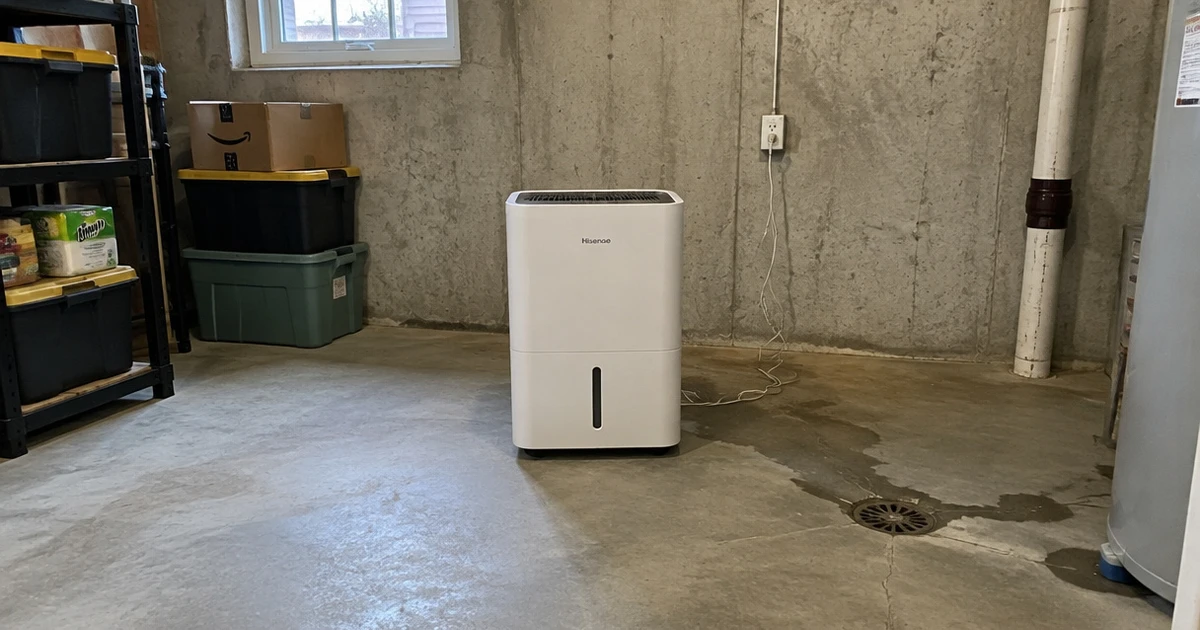
Start with your basement’s size and moisture level, then think about how you’ll drain and run the unit. A model that fits your routine can be easier to live with than one chosen by capacity alone.
Capacity and Coverage
Daily capacity tells you how much moisture a unit can remove under set conditions. Coverage gives you a rough guide to the size of the space it can handle, but a very damp basement may need more capacity than a dry room of the same size.
Use both numbers as a starting point. If your basement has several rooms, closed doors, or damp corners, you may need to run the unit near the problem area or choose a higher capacity. The table shows broad size ranges to help you compare.
| Daily capacity | Typical space | What to check |
|---|---|---|
| 28 to 40 pints | Small to mid-size basement | Room size and dampness |
| 80 pints | Large basement | Coverage and drainage |
Humidity Settings
Look for a clear humidity readout and a target setting you can adjust. Many basement owners aim for roughly 45% to 50% relative humidity, then change the setting if the room still feels damp or becomes uncomfortably dry.
A broad adjustment range gives you more control as seasons and conditions change. Some units let you set a target between 30% and 80% RH, while others extend the range higher. A built-in humidity monitor can help the unit respond as the room changes, instead of running at one fixed level.
Drainage and Tank Size
A water tank works if you can empty it often, but a small tank can fill quickly in a damp basement. Check the tank capacity and whether the unit stops when the tank fills. A full-tank light can also help you spot when it needs attention.
A hose connection can reduce trips to the sink or floor drain, especially during humid weather. Check that the hose can reach your drain and that the unit can sit close enough for a steady flow. Before you choose, think through these practical points:
- How often you can empty a tank
- Where a drain sits in relation to the unit
- Whether the hose length suits your setup
Noise and Placement
Basement noise matters if you use the space as a bedroom, office, or family room. Compare the listed sound level and check whether a quiet or sleep mode lowers fan noise. A reading around 35 to 45 dB can be useful when you want the unit to run near occupied rooms.
Placement affects how well air moves through the room. Leave open space around the intake and outlet, and avoid pushing the unit behind boxes or furniture. If you need to move it between rooms, check for handles or wheels and consider how much effort that will take.
Energy Use and Controls
A dehumidifier may run for long stretches, so energy efficiency matters alongside daily capacity. Look for an ENERGY STAR label and compare it with the size of the unit and the area you need to dry. A more powerful model may suit a large, damp basement, while a smaller space may not need that much capacity.
Simple controls can make daily use easier. A timer helps you choose when the unit runs, while power-off memory can restore settings after an outage. Check for washable filters and an easy-to-reach filter cover, since dust buildup can restrict airflow and add another chore to your routine.
Which Dehumidifier Fits Your Basement?
For a large basement, the AEOCKY RHEA-001 stands out with 80-pint daily capacity, coverage up to 5,500 square feet, and a low fan setting of 44 dB. The KNKA is another large-space option if quiet operation and its 1.45-gallon tank suit your needs. The Waykar covers up to 5,000 square feet, while the Yaufey offers mode flexibility.
For a smaller space, the ozeeco pairs a 35 dB sleep mode with coverage up to 2,500 square feet. The SEMKAP supports continuous use with a 2.5-liter tank and hose, and the VEAGASO fits a mid-size room. Choose the PSOS for a small room where its compact capacity and 28 dB noise level match your needs.
Frequently Asked Questions
What humidity level should you set in a basement?
A setting around 45% to 50% relative humidity works for many basements. If the room still feels damp, lower the target and see how it responds. A separate hygrometer can help you check the reading if you think the unit’s sensor gives an unusual result.
Where should you place a basement dehumidifier?
Set it in an open spot with space around its air intake and outlet. Keep it near a drain if you plan to use a hose, and place it on a level floor. Boxes and furniture can block airflow, so leave a clear path around the unit.
How often do you need to empty the water tank?
How often you empty it depends on the tank size and how much moisture the unit removes. A small tank may need attention more often in a damp basement. Check the tank regularly, or use a drain hose if your unit supports one and you have a suitable drain nearby.
Can a dehumidifier fix a wet basement?
A dehumidifier can reduce moisture in the air, but it cannot repair a leak or stop water from entering through walls or floors. If you see standing water or repeated seepage, address the source first. Running a unit may help with damp air after you deal with the water problem.
How much capacity do you need for a basement?
Start with the basement’s square footage, then account for how damp it feels and how often you plan to run the unit. A small, mostly dry space may need less capacity than a large, persistently damp area. Check both the daily capacity and coverage rating before choosing.